outreach
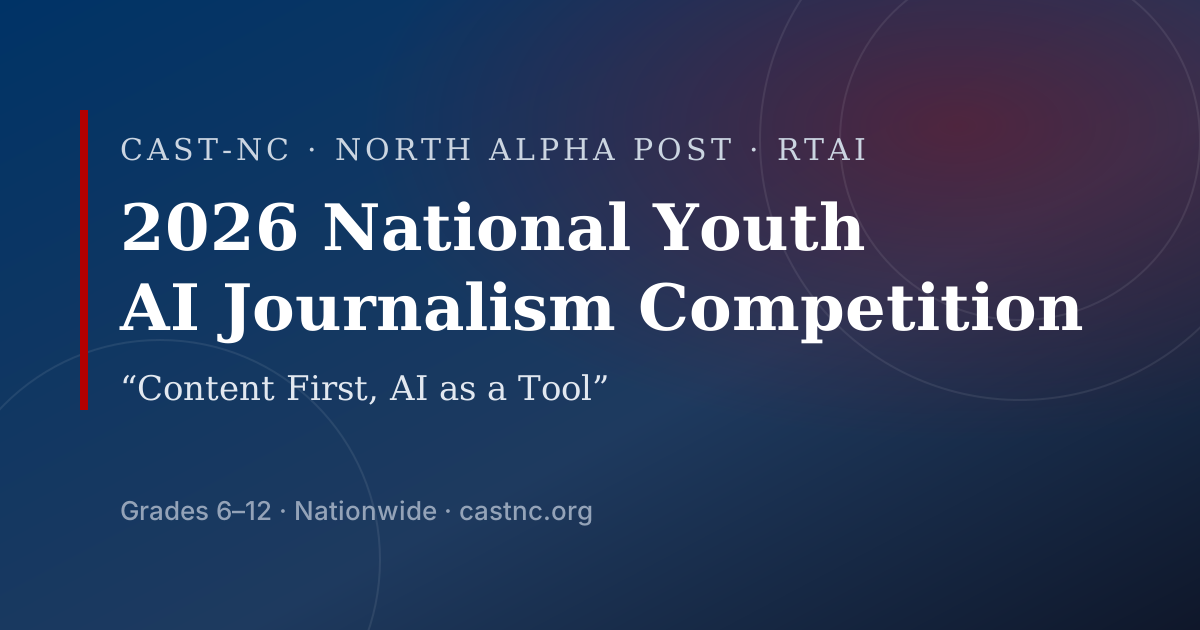
2026 National Youth AI Journalism Competition
2026-07-01
Nationwide (online submissions)
Date
2026-07-01
Time
See details
Location
Nationwide (online submissions)
Results were announced on October 9, 2026 — see the winners. Participants can look up their certificate by name.
"Content First, AI as a Tool." A first-of-its-kind youth AI journalism competition, inviting students in grades 6–12 from across the United States and around the world to share their experience and creativity in using AI, and to explore how young people observe, record, and tell the stories of the world in the AI era.
Organizers
North Alpha Post(北美发布) — North Alpha Post is a comprehensive media and information outlet serving the North and South Carolina Chinese communities, as well as a global audience. The platform is dedicated to documenting community growth and fostering civic engagement, maintaining a global outlook while addressing the practical, everyday requirements of the regional Chinese community.
Chinese-American Association for Science and Technology – NC Chapter (CAST-NC) — CAST-NC is a nonprofit organization focused on promoting science and technology advancement. It supports professional exchange, organizes meetings, produces publications related to science and technology, and conducts fundraising activities to support its mission.
Research Triangle AI Society (RTAI) — RTAI is a nonprofit organization dedicated to advancing the understanding and application of artificial intelligence in the North Carolina Research Triangle area and beyond. Its mission is to foster collaboration, education, and innovation in AI to address real-world challenges and create opportunities for growth.
Sponsors & Supporters
- iPearl — Gold Sponsor
- MOVENC — Silver Sponsor
- Taipei 101 — Friendship Sponsor
The organizers welcomed more businesses, institutions, and individuals to support the competition. Sponsorship contact: president@castnc.org.
Mission and Goals
- Encourage young people to engage with their local communities
- Cultivate critical thinking, communication, storytelling, and media literacy skills
- Promote responsible, ethical, and transparent use of AI technologies
- Support youth participation in community journalism
- Encourage authentic, objective, and insightful reporting
- Build bridges among multicultural communities, schools, families, and civic organizations
The competition welcomed students from all ethnic, cultural, and language backgrounds — no prior journalism experience required.
Awards
- First Prize: 2 winners × $300
- Second Prize: 4 winners × $200
- Third Prize: 6 winners × $100
- Honorable Mentions / Special Recognition: multiple winners
Champions and other awards were to be decided live at the final round.
Timeline
- July 1, 2026 — Submissions open
- September 25, 2026 — Submission deadline
- September 2026 — Preliminary review
- September or October 2026 (tentative) — Finals, Awards Ceremony & Sharing Session (in person and online)
- October 9, 2026 — Final results announced
- Ongoing — Selected entries published progressively on North Alpha Post
Eligibility
- Open to students in grades 6–12, or youth of an equivalent age, from across the United States and around the world
- No journalism experience required — students of all ethnic, cultural, and language backgrounds were welcome
- Participate as an individual entrant. Team submissions were not accepted
Submission Themes and Format
"News" here does not have to mean major events — it starts with what is new: people and stories that recently happened, were newly discovered, and deserve to be known by more people, presented through the student's own observation, interviews, photography, and storytelling.
Recommended Themes
- Campus life — new changes, activities, issues, and people at school
- Community stories — community events, volunteer service, cultural festivals, public-interest initiatives, local people
- Technology and innovation — tech in everyday life, startup stories, robotics, experiences with AI tools
- Multicultural experiences — immigrant families, growing up bilingual, holiday traditions, cross-cultural exchange
- Youth perspectives — the pressures, interests, social lives, college paths, sports, arts, and futures students care about
- Public-interest issues — new policies, phenomena, or challenges affecting students, families, and communities
- People stories — noteworthy people, teams, teachers, students, parents, or community members
Topics did not need to be grand, but they should be real, fresh, observant, and grounded in first-hand experience.
Submission Formats
- Entries could be submitted in English or Chinese
- Written report (with images): at least 600 words, accompanied by photos or charts as needed
- Video report: up to 5 minutes, uploaded to YouTube with the link submitted
Submissions were open from July 1 to September 25, 2026. For questions, contact the organizers at info@castnc.org.
Submission Standards
- Be original
- Uphold journalistic integrity
- Include proof of personal involvement
- Clearly report how AI was used in the production process
- Disclose which AI tools were used: ChatGPT, Grammarly, Canva AI, other AI tools
- Submit relevant prompts, AI usage notes, or process documentation
- Follow the age policies of all AI tools used
- Obtain parental supervision or permission before using any AI tool with age restrictions or limitations
Judging Criteria
At the finals, shortlisted students presented their creative process live — where the story idea came from, whether they conducted interviews or filming, how AI tools were involved and what they contributed, and how the student verified and revised the final work. Judges considered:
- Journalistic Quality and Accuracy — The submission should demonstrate strong reporting, factual accuracy, clear structure, credible sources, and journalistic integrity.
- Responsible and Transparent AI Usage — Participants must clearly explain how AI tools were used, submit prompts or AI usage notes, and show that human judgment guided the final work.
- Originality and Creativity — The work should present an original topic, perspective, format, storytelling approach, or community insight.
- Ethics, Fairness, and Accountability — The submission should avoid plagiarism, misinformation, bias, fabricated sources, undisclosed synthetic content, and misleading use of AI.
- Community Relevance and Impact — The story should address a topic that is meaningful to its audience, school, local community, youth community, or broader society.
- Presentation and Audience Engagement — The final article or video should be clear, polished, engaging, and appropriate for the chosen format.
AI Usage Policy
AI is used as a supporting tool, but the student must remain the primary reporter, creator, and decision-maker.
Participants may use AI tools for:
- Brainstorming story ideas
- Preparing interview questions
- Organizing research notes
- Grammar and style editing
- Translation assistance
- Headline suggestions
- Data organization or visualization support
- Photo, audio, or video editing assistance
- Improving clarity, structure, or presentation
Participants must disclose:
- Which AI tools were used
- What the tools were used for
- Which parts of the work were AI-assisted
- What prompts or instructions were given to AI tools
- How the student reviewed, revised, verified, and finalized the work
- Whether AI was used to generate or edit photos, audio, or video
Participants must not:
- Submit work that is mostly AI-generated with minimal personal involvement
- Fabricate interviews, quotes, sources, events, or data
- Use AI-generated facts without verification
- Present AI-generated images, audio, or video as real without disclosure
- Use AI to impersonate another person
- Copy published work without proper attribution
- Submit misleading, defamatory, discriminatory, or harmful content
- Use AI tools in violation of the tool's age policy or terms of use
Simple prompting alone is not sufficient. Strong submissions should show meaningful integration of journalism, human judgment, and responsible AI use.
Youth Safety, Privacy, and Consent
Because participants are minors and may report on real people and communities, all entries must follow safety and privacy standards. Participants must:
- Obtain permission before photographing, recording, or interviewing others
- Obtain appropriate consent before interviewing or identifying minors
- Avoid publishing private personal information
- Avoid exposing sensitive information related to health, immigration status, finances, family matters, school discipline, or personal identity
- Respect the dignity, privacy, and safety of all individuals involved
- Clearly label or disclose any AI-generated or AI-edited media
- Follow school, family, and community safety expectations when reporting
The organizers reserve the right to reject, delay, edit, or remove any submission that raises safety, privacy, legal, ethical, or quality concerns.
Liability for Submissions
Participants are fully responsible for the content, accuracy, originality, legality, and ethical integrity of their submissions. By submitting an entry, each participant, together with their parent or legal guardian if the participant is a minor, confirms that the work does not contain unlawful, defamatory, plagiarized, misleading, harmful, privacy-violating, copyright-infringing, or otherwise inappropriate content.
The organizers, co-organizers, judges, sponsors, partners, volunteers, and affiliated organizations are not responsible for any claims, damages, disputes, or legal consequences arising from a participant's submission, publication, promotion, or distribution of the entry. Participants and their parent or legal guardian agree to accept full responsibility and hold the above parties harmless to the fullest extent permitted by law.
The organizers reserve the right to reject, remove, or disqualify any submission that may violate competition rules, legal requirements, journalistic standards, privacy rights, intellectual property rights, or community safety standards.
Publication Rights and Permissions
Selected entries may be published progressively on North Alpha Post and may also be shared through organizer websites, newsletters, social media, event materials, or partner platforms. Participants retain ownership of their original work.
By submitting to the competition, participants and their parent or guardian grant the organizers permission to:
- Review and judge the submission
- Publish the submission
- Lightly edit the work for grammar, formatting, clarity, or publication style
- Promote the submission and competition
- Use the participant's name, school or organization, award status, and approved photos or videos for competition-related publicity
Substantial edits should be reviewed with the participant before publication whenever possible. Parent or guardian consent is required before any student work, name, image, or award information is publicly published.