seminar
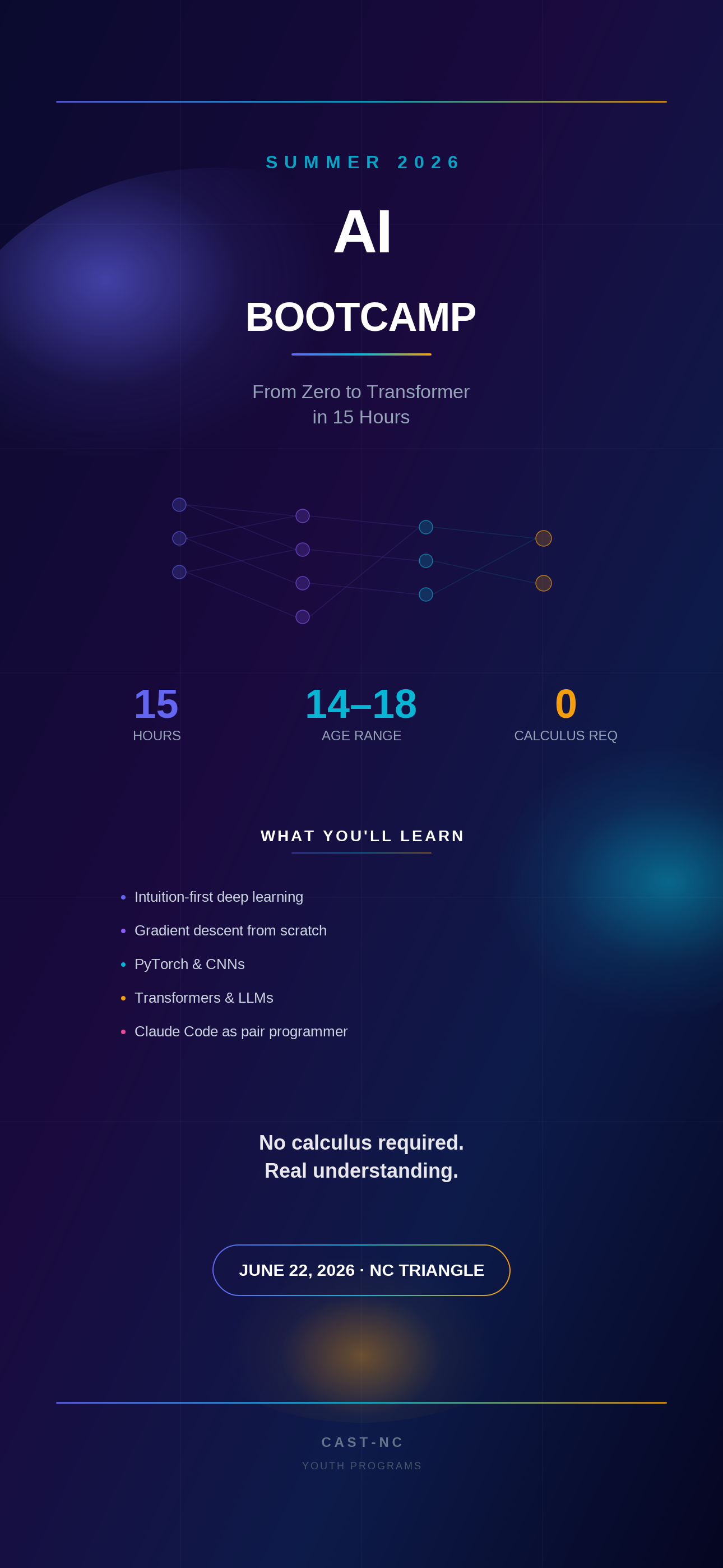
Summer AI Bootcamp: From Zero to Transformer in 15 Hours
2026-06-22
NC Triangle Area
Date
2026-06-22
Time
See details
Location
NC Triangle Area
High school students can genuinely understand how deep learning works — not just how to use it — if we lead with intuition instead of formalism. That's the conviction at the heart of this 15-hour bootcamp. Every major concept is introduced visually and through working code before any equation appears. No calculus is required.
The Big Idea
In Hour 1, every student articulates an AI project they're personally excited about. That idea becomes the motivating thread woven through all 15 hours. By the end, students aren't starting from zero — they're applying a toolkit they genuinely understand to build something they care about.
Why Claude Code at the Center?
Most high school AI courses are too shallow — drag-and-drop tools with no real understanding. Claude Code lowers the activation energy for getting started while demanding that students read, explain, and critique every line it produces. The classroom norm is: "You can use Claude Code, but you must be able to explain what it did."
Students learn to prompt with goals, constraints, and context — a transferable skill in itself. Claude Code acts as a pair programmer, not an answer machine.
15 Hours at a Glance
Hours 1–5: Foundations
Python review, passion project brainstorm, AI landscape, Claude Code setup, NumPy, pandas, matplotlib, vectors & probability, first ML project with linear regression.
Hours 6–10: Deep Learning Core
Gradient descent from scratch, logistic regression, MNIST, neurons to networks, backprop intuition, PyTorch fundamentals, training tricks & overfitting.
Hours 11–15: Modern AI
Convolutional networks, CNN architecture, VGG & ImageNet history, transfer learning, attention mechanism, Transformers, and LLM basics.
What Students Walk Away With
By Hour 15, students have touched every layer of the stack — from raw arrays to Transformers — and have felt the training loop in their hands at each level. They understand what data requirements look like, what overfitting feels like, and how to fine-tune a pretrained model for a new task. Most importantly, they've internalized the habit of using AI as a collaborator rather than a crutch.